
- Browse Category
Subjects
 We Begin at the EndLearn More
 - Choice Picks
- Top 100 Free Books
- Blog
- Recently Added
- Submit your eBook
- Browse Category
We Begin at the EndLearn More
- Choice Picks
- Top 100 Free Books
- Blog
- Recently Added
- Submit your eBook
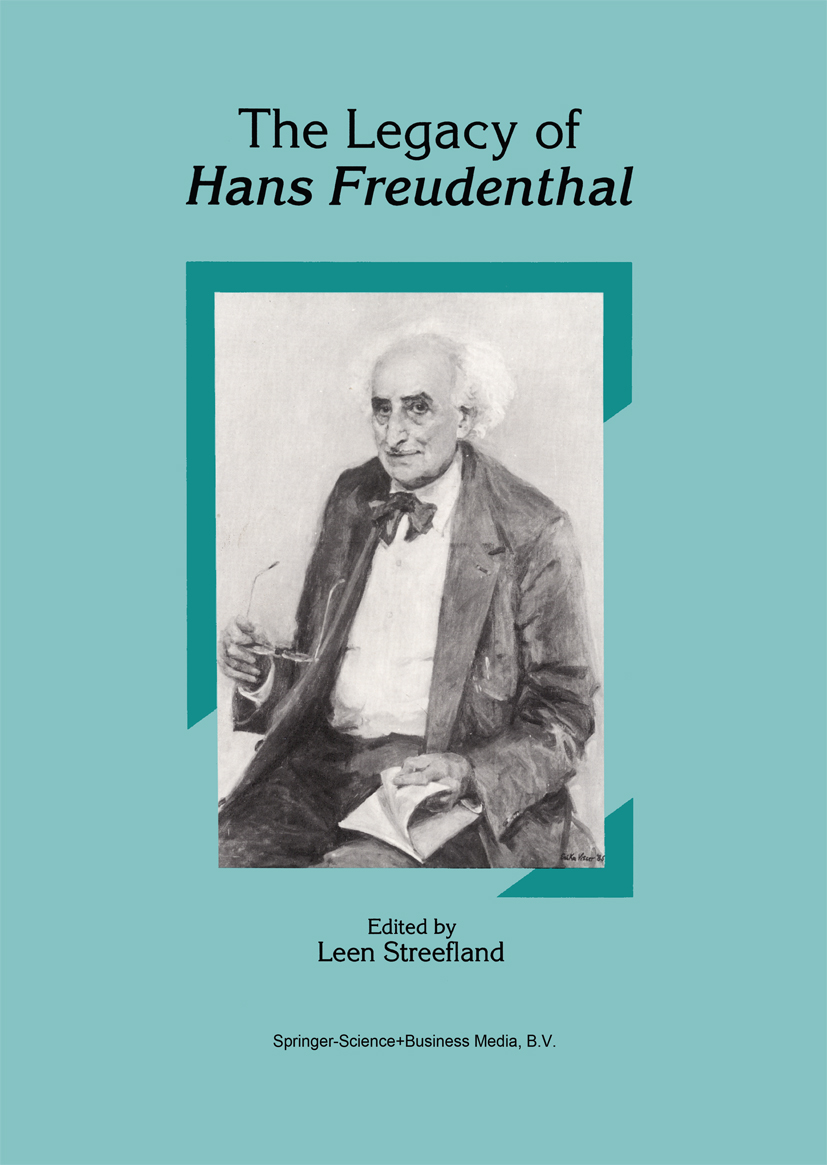
The Legacy of Hans Freudenthal
2020-09-19 00:04:51
The Legacy of Freudenthal pays homage to Freudenthal and his work on mathematics, its history and education. Almost all authors were his scholars or co-workers. They testify to what they learned from him. Freudenthal himself contributes posthumously....
Read more
The Legacy of Freudenthal pays homage to Freudenthal and his work on mathematics, its history and education. Almost all authors were his scholars or co-workers. They testify to what they learned from him. Freudenthal himself contributes posthumously. His didactical phenomenology of the concept of force is both provocative and revealing in its originality, compared with what is usually found in physics instruction. Freudenthal is portrayed as a universal human being by Josette Adda. He made considerable contributions to mathematics itself, e.g. on homotopy theory and Lie groups in geometry. The exposition of Freudenthal's mathematical life and work is on Van Est's account. Henk Bos discusses his historical work. The essay review of the 8th edition of Hilbert's Grundlagen der Geometrie serves as a vehicle of thought. The main part of the book, however, concerns Freudenthal's work on mathematics education. Christine Keitel reviews his final book Revisiting Mathematics Education (1991). Fred Goffree describes Freudenthal's `Working on Mathematics Education' both from an historical as well as a theoretical perspective. Adrian Treffers analyses Freudenthal's influence on the development of realistic mathematics education at primary level in the Netherlands, especially his influence on the Wiskobas-project of the former IOWO. Freudenthal once predicted the disappearance of mathematics as an individual subject in education sometime around the year 2000, because it would by then have merged with integrated thematic contexts. Jan de Lange anticipates this future development and shows that Freudenthal's prediction will not come true after all. Reflective interludes unveil how he might have influenced those developments. Freudenthal contributed a wealth of ideas and conceptual tools to the development of mathematics education -- on contexts, didactical phenomenology, guided reinvention, mathematisation, the constitution of mental objects, the development of reflective thinking, levels in learning processes, the development of a mathematical attitude and so on -- but he did not design very much concrete material. Leen Streefland deals with the question of design from a theoretical point of view, while applying Freudenthal's ideas on changing perspective and shifting. For teachers, researchers, mathematics educators, mathematicians, educationalists, psychologists and policy makers.
Less

Compare Prices
| Store | Availability | Book Format | Condition | Price |
|---|---|---|---|---|
| Indigo Books & Music | In Stock | Paperback | Paperback | Buy CAD 199.89 |
| eBooks.com | In Stock | PDF (drm free, digitally watermarked) | PDF (drm free, digitally watermarked) | Buy AUD 189.00 |
| Indigo Books & Music | In Stock | Hard Cover | Hard Cover | Buy CAD 170.96 |
| BetterWorld.com - New, Used, Rare Books & Textbooks | In Stock | Buy USD 17.47 |
eBooks.comIn Stock
Format
PDF (drm free, digitally watermarked)
Condition
PDF (drm free, digitally watermarked)
Available Discount
No Discount available
Related Books
View All
The Elson Readers, Book 5
State And The Rise Of National Education Systems
Japanese Grammar
Cambridge International AS and A Level Business Coursebook Digital Edition
Modern Prose And Poetry; For Secondary Schools

Because of Winn-Dixie

A Romany of the Snows, Vol. 3 Being a Continuation of the Personal Histories of 'Pierre and His People' and the Last Existing Records of Pretty Pierre
 Origini Della Lotta Attuale (476-1887); Quinta Edizione.jpeg)
La Lotta Politica in Italia, Volume II (Of 3) Origini Della Lotta Attuale (476-1887); Quinta Edizione
100 Math Workouts

Civilization the Primal Need of the Race, and the Attitude of the American Mind Toward the Negro Intellect the American Negro Academy. Occasional Paper No. 3
Creating Cultures of Thinking
Inequality in the Promised Land
Higher Education in Post-war Great Britain

General History for Colleges and High Schools

Capt. W. F. Drannan, Chief of Scouts: As Pilot to Emigrant and Government Trains, Across the Plains of the Wild West of Fifty Years Ago...

The Old Humanities and the New Science
Passing the Literacy Skills Test

How Did I Get Here? From a Kushite to a Thug.

John Thorndykes cases

Environmental Education in China

A Manual of Pronunciation

The Preface to the Aeneis of Virgil

Parker's Second Reader
Reflective Practice

A School History of the United States

Settings
Reflow text when sidebars are open.
