
- Browse Category
Subjects
 We Begin at the EndLearn More
 - Choice Picks
- Top 100 Free Books
- Blog
- Recently Added
- Submit your eBook
- Browse Category
We Begin at the EndLearn More
- Choice Picks
- Top 100 Free Books
- Blog
- Recently Added
- Submit your eBook
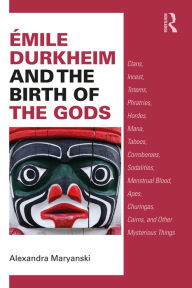
Émile Durkheim and the Birth of the Gods: Clans, Incest, Totems, Phratries, Hordes, Mana, Taboos, Corroborees, Sodalities, Menstrual Blood, Apes, Chur
2020-05-14 09:45:04
The Birth of the Gods is dedicated to Durkheim's effort to understand the basis of social integration. Unlike most social scientists, then and now, Durkheim concluded that humans are naturally more individualistic than collectivistic, that the primal...
Read more
The Birth of the Gods is dedicated to Durkheim's effort to understand the basis of social integration. Unlike most social scientists, then and now, Durkheim concluded that humans are naturally more individualistic than collectivistic, that the primal social unit for humans is the macro-level unit ('the horde'), rather than the family, and that social cohesion is easily disrupted by human self-interest. Hence, for Durkheim, one of the gravest problems facing sociology is how to mold these human proclivities to serve the collective good. The analysis of elementary religions, Durkheim believed, would allow social scientists to see the fundamental basis of solidarity in human societies, built around collective representations, totems marking sacred forces, and emotion-arousing rituals directed at these totems. The first half of the book traces the key influences and events that led Durkheim to embrace such novel generalizations. The second part makes a significant contribution to sociological theory with an analysis that essentially tests Durkheim's core assumptions using cladistic analysis, social network tools and theory, and data on humans closest living relatives—the great apes. Maryanski marshals hard data from primatology, paleontology, archaeology, genetics, and neuroscience that enlightens and, surprisingly, confirms many of Durkheim’s speculations. These data show that integration among both humans and great apes is not so much group or kin oriented, per se, but orientation to a community standing outside each individual that includes a sense of self, but also encompassing a cognitive awareness of a sense of community or a connectedness that transcends sensory reality and concrete social relations. This community complex, as Maryanski terms it, is what Durkheim was beginning to see, although he did not have the data to buttress his arguments as Maryanski is able to do.
Less

Compare Prices
| Store | Availability | Book Format | Condition | Price |
|---|---|---|---|---|
| Barnes & Noble | In Stock | NOOK Book | NOOK Book | Buy USD 37.99 |
Available Discount
No Discount available
Related Books
View All
Sacred Assemblies and Civic Engagement: How Religion Matters for America's Newest Immigrants

The Suppression of the African Slave Trade to the United States of America 1638-1870

The Conservation of Races

American Institutions and Their Influence

The State of Society in France Before the Revolution of 1789

A General View of Positivism

The Elementary Forms of the Religious Life

War-What For?

Mankind in the Making

The Man-Made World; Or, Our Androcentric Culture
.jpg)
Democracy In America - Volume 2 (of 2)

Indians of the Yosemite Valley and Vicinity: Their History, Customs and Traditions

The Negro Problem
.jpg)
Democracy In America - Volume 1 (of 2)

In the Wrong Paradise, And Other Stories

Éducation et sociologie

Sardar Patel And Communal Issues Of Kashmir

L'ancien régime et la révolution

An Accursed Race

A New Conscience and an Ancient Evil

Criminal Sociology. Authorized Edition

Le Suicide; Etude de Sociologie
.jpg)
Die Entwicklung des gutsherrlich-bäuerlichen Verhältnisses in Galizien (1772-1848)
Black Cultural Traffic: Crossroads in Global Performance and Popular Culture Harry J. Elam Editor

An Inquiry Into The Nature Of Peace And The Terms Of Its Perpetuation

Settings
Reflow text when sidebars are open.
